Case study lead in Europe
The case study on lead in Europe illustrates the Integrated Monitoring framework by evaluating the associations between environmental monitoring data on lead and biomonitoring data on lead. The case study aimed at integrating data at population level, covering EU member states. Environmental data for lead were collected, as well as biomonitoring data. Data were processed to reach a consistent database, after which statistical techniques were used to assess the potential association between lead biomonitoring results and environmental levels.
Scope
Lead is one of the environmental chemicals which has been studied since long. Information on its occurrence in the environment and in food is studied extensively. Lead is also one of the chemicals, which is extensively studied in biomonitoring programs.
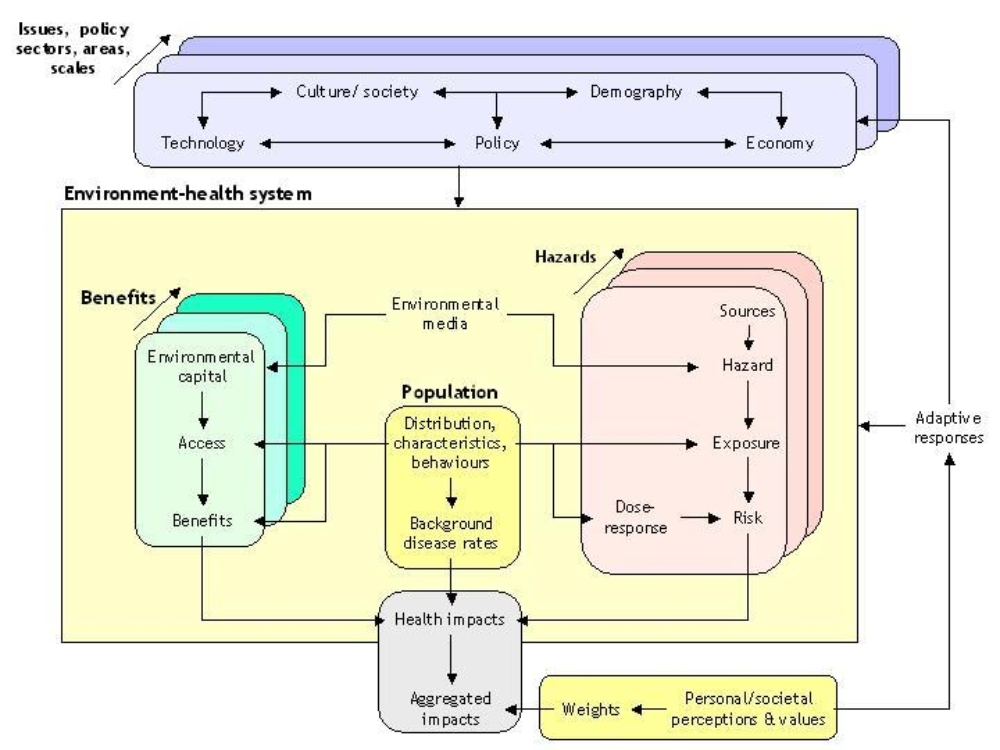
The case study on lead allows us to assess the integration of environmental data and biomonitoring data at population level. The causal chain for exposure to lead is given in Figure 1.

Figure 1: Causal chain for lead exposure
Assessment Methods
Step 0 - Define goal
We have chosen the case study lead to illustrate the integration of environmental and biomonitoring data. The objective of the work undertaken was to explore whether it is possible to predict blood lead levels in the European population from present and past environmental informatiion.
Step 1 - Make integrated plan
Exposure to lead mainly occurs through the following pathways:
- outdoor and indoor air
- soil and settled house dust
- food and drinking water.
Available data on occurrence of lead in outdoor air, in soil and settled house dust and in drinking water were collected. Results of dietary intake studies were collected. The collection aimed at data available in European-level databases and studies, but was complemented with results from scientific literature and publicly available reports. Biomonitoring data were already available from an earlier assessment of lead biomonitoring data (Smolders et al., 2010). They were complemented with new data from scientific literature and publicly available reports.
After collection of the data, the information was put in a database and each data source was analyzed with regard to data gaps, data limitations and consistency with the other data. From the data analysis phase, a coherent database was made with records characterized by population identifiers, blood lead level, soil and air lead levels and dietary lead intake.
The association between blood lead and environmental factors was first explored in a univariate statistical regression. Multivariate statistiscal techniques were then used on the variables that showed significant association in the univariate regression.
Step 2 - Collect data
The data from the biomonitoring studies (blood lead levels), reported in Smolders et al. (2010) were put in the database. They were complemented with results from other studies, found from a literature search and an internet search. Results from partners within Intarese were obtained as well. Statistical descriptors were put in the database, together with information on country/region, year of study, age and gender of study population.
Air lead concentrations were extracted from the Airbase vs3 database of the European Environment Agency (http://air-climate.eionet.europa.eu/databases/airbase/ ). Additional data were retrieved from literature and from the Voluntary Risk Assessment Report on Pb (VRAR, 2007). Concentrations and their attributes (year, region, type of location) were put in the database.
Soil lead concentrations were retrieved from the FOREGS database, which provides geochemical baseline soil data for Europe (http://www.gtk.fi/publ/foregsatlas/). The data were complemented from references in the Voluntary Risk Assessment Report on Pb (VRAR, 2007) and from scientific literature. Concentrations were put in the database with information on sampling year and location.
Concentrations in settled dust were collected from scientific literature and published studies and put in the database.
Concentrations in drinking water were obtained from the VRAR (2007), from scientific literature and from drinking water companies (Belgium).
Available food intake studies were identified and results were put in the database. No distinction was made between duplicate meal, total diet or market basket studies. We used information from the VRAR (2007), the EU SCOOP 2004 study on dietary exposure to arsenic, cadmium, lead and mercury. Information for earlier years was taken from the inventory of Bierkens et al. (2006). Additional searches were done in the scientific literature. Intake, year of study and region were stored in the database.
Step 3 - Analyze data
The description of the full dataset is provided in Annex (load file) XXX.
Blood lead data were organized by country/region and were further characterized by year of study, age group and gender. The database was then analyzed to provide matching data on environmental levels and dietary intake for each of the blood lead entries. Analysis was done on median blood lead concentrations, being the most reported descriptor. Gender information was not always available, resulting in three entries for gender: male, female, unknown. Age groups were not consistent across studies. Studies were therefore classified in rather broad groups: adults, secondary school children, primary school children and preschool children.
Median air lead concentrations were chosen as the air lead metric. Most data related to lead on total suspended matter. PM10 values were available for some countries and more recent years. As the availability overlapped with the data for total suspended matter, PM10 results were not used for reasons of consistency. Data for missing years were replaced by data for the nearest year.
The only consistent data set for lead in soil is the FOREGS database. Data were collected in 1997. No time trend data are available for Pb in soil. As Pb is rather immobile in soil, no significant changes are expected over time in the absence of emission sources. The FOREGS database has a number of drawbacks. It is intended to provide a geochemical background of trace element concentrations and is thus not representative for lead concentrations that people are exposed to in daily life. As well, the number of sampling points per country is rather limited, although related to country size. The total FOREGS dataset for Pb consists of 840 samples from 26 countries.
The dataset for lead intake from food combined information from various types of dietary intake studies (market basket, total diet, duplicate meal) to provide a dataset as complete as possible. However, it is known that the different methods to estimate dietary intake do result in different results. Missing data were filled in by using information from the nearest year or the nearest country. Age-dependency of dietary lead intake was established on the basis of available data and used if country/year data were missing for a certain age group.
No adequate data were found for lead in settled dust. Only scattered information from specific studies is available. Some studies report relationships between concentrations in settled dust and soil or air, but the relationships are divergent and can thus not be used to fill in missing data.
There is no readily available information on drinking water quality in Europe. Although there is a reporting obligation at EU level, the publicly available information is not in a format that allows to extract country-specific concentrations. As well, intake from drinking water is sometimes included in the dietary intake studies. Having only 4 countries with drinking water information, drinking water was not taken forward to the statistical analysis.
The resulting dataset that was used in the statistical analysis is given in table 1.
Table 1: Description of the dataset used in the statistical analysis
|
Country Code |
Year |
Gender |
Age group |
B-Pb |
B-Pb |
Air |
Soil |
Food Intake |
|
mg/dl |
µg/m3 |
mg/kg dm |
mg/d |
|||||
|
N |
Median |
|||||||
|
BE |
2006 |
1 |
5 |
1 |
1.82 |
0.0010 |
37.30 |
25.60 |
|
1 |
6 |
1 |
3.69 |
0.0010 |
37.30 |
25.60 |
||
|
2007 |
0 |
3 |
2 |
1.65 |
0.0010 |
70.25 |
11.70 |
|
|
1 |
3 |
2 |
2.10 |
0.0010 |
70.25 |
11.70 |
||
|
2008 |
0 |
3 |
2 |
2.62 |
0.0010 |
208.90 |
11.70 |
|
|
1 |
3 |
2 |
2.47 |
0.0010 |
208.90 |
11.70 |
||
|
CZ |
1995 |
0 |
6 |
1 |
1.51 |
0.4430 |
22.32 |
18.50 |
|
1 |
4 |
1 |
4.06 |
0.0147 |
22.14 |
37.70 |
||
|
1 |
6 |
1 |
4.00 |
0.1080 |
22.14 |
142.00 |
||
|
2 |
4 |
4 |
4.00 |
0.0147 |
22.14 |
13.50 |
||
|
2 |
6 |
2 |
4.78 |
0.0147 |
22.14 |
19.00 |
||
|
1996 |
1 |
4 |
1 |
3.00 |
0.0147 |
22.14 |
37.70 |
|
|
1998 |
1 |
4 |
1 |
3.20 |
0.0147 |
22.14 |
37.70 |
|
|
1999 |
1 |
4 |
1 |
3.40 |
0.0147 |
22.14 |
37.70 |
|
|
1 |
6 |
1 |
2.82 |
0.0890 |
22.14 |
25.00 |
||
|
2001 |
0 |
6 |
1 |
1.63 |
0.4443 |
22.32 |
37.00 |
|
|
1 |
4 |
2 |
3.00 |
0.0147 |
22.14 |
37.70 |
||
|
1 |
6 |
1 |
2.50 |
0.0350 |
22.14 |
37.70 |
||
|
2004 |
1 |
6 |
1 |
2.71 |
0.0140 |
22.14 |
25.00 |
|
|
2007 |
1 |
6 |
1 |
2.48 |
0.0110 |
22.14 |
25.00 |
|
|
DE |
1981 |
0 |
6 |
1 |
1.47 |
0.4430 |
22.32 |
37.00 |
|
1 |
6 |
1 |
8.07 |
0.4430 |
22.32 |
142.00 |
||
|
1983 |
2 |
4 |
2 |
8.60 |
0.4430 |
22.32 |
13.50 |
|
|
1984 |
0 |
6 |
1 |
1.58 |
0.3145 |
22.32 |
37.00 |
|
|
1985 |
0 |
6 |
1 |
1.93 |
0.3145 |
22.32 |
37.00 |
|
|
DE |
1 |
6 |
1 |
7.26 |
0.4443 |
22.32 |
142.00 |
|
|
1986 |
0 |
6 |
1 |
1.79 |
0.1860 |
22.32 |
37.00 |
|
|
1 |
6 |
1 |
6.06 |
0.3145 |
22.32 |
142.00 |
||
|
1987 |
0 |
6 |
1 |
1.43 |
0.1880 |
22.32 |
37.00 |
|
|
1 |
6 |
2 |
5.70 |
0.3145 |
22.32 |
142.00 |
||
|
2 |
4 |
2 |
2.10 |
0.0200 |
22.32 |
13.50 |
||
|
1988 |
0 |
6 |
1 |
2.24 |
0.1880 |
22.32 |
37.00 |
|
|
1 |
6 |
1 |
5.12 |
0.1860 |
22.32 |
142.00 |
||
|
1989 |
0 |
6 |
1 |
1.86 |
0.1040 |
22.32 |
37.00 |
|
|
1 |
6 |
1 |
5.33 |
0.1880 |
22.32 |
142.00 |
||
|
1990 |
0 |
6 |
1 |
2.16 |
0.1040 |
22.32 |
37.00 |
|
|
1 |
6 |
1 |
5.09 |
0.1880 |
22.32 |
142.00 |
||
|
1991 |
0 |
6 |
1 |
1.59 |
0.1040 |
22.32 |
37.00 |
|
|
1 |
6 |
1 |
4.50 |
0.1040 |
22.32 |
142.00 |
||
|
2 |
4 |
2 |
5.00 |
0.1010 |
22.32 |
13.50 |
||
|
1992 |
0 |
6 |
2 |
2.60 |
0.1080 |
22.32 |
37.00 |
|
|
1 |
6 |
2 |
3.96 |
0.1040 |
22.32 |
83.50 |
||
|
2 |
4 |
2 |
3.30 |
0.1000 |
22.32 |
13.50 |
||
|
1993 |
0 |
6 |
2 |
3.95 |
0.1080 |
22.32 |
37.00 |
|
|
1 |
6 |
2 |
4.20 |
0.1080 |
22.32 |
142.00 |
||
|
2 |
4 |
4 |
3.75 |
0.1000 |
22.32 |
13.50 |
||
|
1994 |
1 |
6 |
1 |
4.97 |
0.1080 |
22.32 |
142.00 |
|
|
2 |
4 |
2 |
3.80 |
0.1020 |
22.32 |
13.50 |
||
|
1995 |
0 |
6 |
3 |
5.32 |
0.0953 |
22.32 |
24.67 |
|
|
1 |
6 |
3 |
2.74 |
0.1080 |
22.32 |
72.47 |
||
|
1996 |
0 |
6 |
3 |
5.76 |
0.0890 |
22.32 |
18.50 |
|
|
1 |
6 |
3 |
2.48 |
0.0890 |
22.32 |
33.47 |
||
|
2 |
4 |
12 |
2.59 |
0.0890 |
22.32 |
13.50 |
||
|
1997 |
0 |
6 |
4 |
8.51 |
0.0805 |
22.32 |
18.50 |
|
|
1 |
6 |
4 |
2.13 |
0.0890 |
22.32 |
34.53 |
||
|
DE |
1997 |
2 |
4 |
2 |
3.50 |
0.0890 |
22.32 |
13.50 |
|
1998 |
0 |
6 |
5 |
1.75 |
0.0672 |
22.32 |
33.30 |
|
|
1 |
6 |
5 |
2.19 |
0.0720 |
22.32 |
32.62 |
||
|
2 |
6 |
8 |
3.04 |
0.0890 |
22.32 |
23.70 |
||
|
1999 |
0 |
6 |
4 |
2.80 |
0.0600 |
22.32 |
37.00 |
|
|
1 |
6 |
5 |
2.56 |
0.0600 |
22.32 |
35.16 |
||
|
2 |
4 |
2 |
2.36 |
1.0200 |
22.32 |
13.50 |
||
|
1999 |
2 |
5 |
2 |
3.05 |
0.0600 |
22.32 |
37.70 |
|
|
2000 |
0 |
6 |
4 |
2.77 |
0.0475 |
22.32 |
32.38 |
|
|
1 |
6 |
5 |
1.84 |
0.0600 |
22.32 |
35.16 |
||
|
2 |
3 |
2 |
2.63 |
0.0560 |
22.32 |
5.80 |
||
|
2 |
4 |
2 |
3.10 |
0.1540 |
22.32 |
13.50 |
||
|
2001 |
0 |
6 |
5 |
3.14 |
0.0350 |
22.32 |
37.00 |
|
|
1 |
6 |
5 |
2.23 |
0.0350 |
22.32 |
35.16 |
||
|
2 |
4 |
6 |
2.54 |
0.6967 |
22.32 |
13.50 |
||
|
2002 |
0 |
6 |
4 |
1.74 |
0.0315 |
22.32 |
37.00 |
|
|
1 |
6 |
4 |
1.27 |
0.0350 |
22.32 |
34.53 |
||
|
2003 |
0 |
6 |
4 |
2.11 |
0.0280 |
22.32 |
37.00 |
|
|
1 |
6 |
4 |
1.59 |
0.0280 |
22.32 |
34.53 |
||
|
2 |
4 |
2 |
1.07 |
3.0200 |
22.32 |
13.50 |
||
|
2004 |
0 |
6 |
5 |
3.10 |
0.0280 |
22.32 |
37.00 |
|
|
1 |
6 |
6 |
2.06 |
0.0280 |
22.32 |
33.47 |
||
|
2005 |
0 |
6 |
4 |
1.61 |
0.0280 |
22.32 |
37.00 |
|
|
1 |
6 |
4 |
1.37 |
0.0280 |
22.32 |
34.53 |
||
|
2 |
6 |
1 |
2.10 |
0.0350 |
22.32 |
23.70 |
||
|
2006 |
0 |
6 |
4 |
2.10 |
0.0240 |
22.32 |
37.00 |
|
|
1 |
4 |
2 |
1.19 |
0.0350 |
22.32 |
37.70 |
||
|
1 |
6 |
4 |
1.35 |
0.0490 |
22.32 |
34.53 |
||
|
2 |
3 |
1 |
1.96 |
0.0350 |
22.32 |
5.80 |
||
|
2 |
4 |
8 |
1.63 |
0.0350 |
22.32 |
13.50 |
||
|
DE |
2006 |
2 |
5 |
1 |
1.46 |
0.0600 |
22.32 |
37.70 |
|
2007 |
0 |
6 |
4 |
2.71 |
0.0200 |
22.32 |
37.00 |
|
|
1 |
6 |
4 |
1.29 |
0.0200 |
22.32 |
34.53 |
||
|
2008 |
0 |
6 |
2 |
4.43 |
0.0200 |
22.14 |
37.00 |
|
|
1 |
6 |
4 |
1.27 |
0.0200 |
22.32 |
34.53 |
||
|
DK |
1994 |
1 |
6 |
1 |
3.92 |
0.1020 |
11.38 |
18.00 |
|
FI |
1999 |
2 |
3 |
3 |
2.23 |
0.0100 |
5.99 |
12.00 |
|
FR |
2005 |
2 |
6 |
1 |
3.10 |
0.0165 |
22.07 |
57.00 |
|
2007 |
2 |
6 |
1 |
3.10 |
0.0165 |
22.07 |
57.00 |
|
|
IT |
2004 |
1 |
6 |
1 |
2.35 |
0.0865 |
21.63 |
44.25 |
|
NL |
1997 |
2 |
6 |
1 |
3.40 |
0.0080 |
19.34 |
9.00 |
|
2005 |
2 |
3 |
4 |
1.92 |
0.0081 |
19.34 |
3.90 |
|
|
2006 |
2 |
3 |
1 |
1.45 |
0.0083 |
19.34 |
3.90 |
|
|
PL |
1991 |
2 |
4 |
4 |
16.50 |
0.0380 |
12.39 |
98.25 |
|
1992 |
2 |
4 |
2 |
10.00 |
0.0380 |
12.39 |
98.25 |
|
|
1993 |
1 |
4 |
2 |
7.35 |
0.0380 |
12.39 |
76.00 |
|
|
2 |
4 |
39 |
8.02 |
0.0380 |
12.39 |
98.25 |
||
|
1994 |
2 |
4 |
7 |
17.78 |
0.0380 |
12.39 |
98.25 |
|
|
1995 |
1 |
4 |
2 |
9.70 |
0.0380 |
12.39 |
76.00 |
|
|
2 |
4 |
4 |
8.16 |
0.0380 |
12.39 |
98.25 |
||
|
1996 |
2 |
4 |
3 |
7.25 |
0.0380 |
12.39 |
98.25 |
|
|
2002 |
2 |
3 |
5 |
2.84 |
0.0380 |
12.39 |
11.90 |
|
|
2004 |
2 |
3 |
4 |
4.11 |
0.0336 |
12.39 |
11.90 |
|
|
PT |
2001 |
2 |
6 |
1 |
6.30 |
0.0200 |
30.73 |
22.00 |
|
2002 |
2 |
6 |
1 |
5.60 |
0.0200 |
30.73 |
22.00 |
|
|
2003 |
2 |
2 |
1 |
2.50 |
0.0200 |
30.73 |
11.90 |
|
|
2004 |
2 |
6 |
1 |
2.40 |
0.0200 |
30.73 |
22.00 |
|
|
2005 |
2 |
2 |
1 |
4.10 |
0.0200 |
30.73 |
11.90 |
|
|
2 |
6 |
1 |
3.40 |
0.0200 |
30.73 |
22.00 |
||
|
2006 |
2 |
6 |
1 |
2.80 |
0.0200 |
30.73 |
22.00 |
|
|
2007 |
2 |
2 |
1 |
2.40 |
0.0200 |
30.73 |
11.90 |
|
|
2 |
6 |
1 |
3.50 |
0.0200 |
30.73 |
22.00 |
||
|
SE |
2004 |
1 |
6 |
1 |
1.53 |
0.0200 |
7.74 |
25.25 |
|
SK |
2005 |
1 |
6 |
1 |
2.79 |
0.0280 |
19.68 |
43.00 |
Step 4 - Analyze integrated data
In a first analysis, the lead biomonitoring data by age were analyzed as a function of time. This would enable comparison with the results of Smolders et al. (2010) for adult women and provide information on influence of age and gender on these relationships.
However, time trends in blood lead levels reflect changes in sources of lead exposure. Identifying the relation between blood lead and these sources would provide means to predict future blood lead levels.
A univariate analysis of blood lead levels by age and gender was first performed to investigate the association between blood lead and air, soil and dietary exposure. Variables identified as being significant in the univariate analysis were then taken forward in a multivariate statistical analysis.
All statistics were performed with Statistica 8.0 from Statsoft, Inc.
Step 5 - Report results
Results are presented in the Results section.
Step 6 - Recommend new action
Recommendations are given in the Appraisal section.
Results
Time trend of blood lead data
The time trend of blood lead data is shown in Figure 2.

Figure 2: Evolution of blood lead levels with time
Data points are shown for adults (men and women) and for primary school children. The other age classes gave no significant correlations. Regression lines on log-basis for adults are shown together with the exponential regression line derived by Smolders et al. (2010). The large variation around the year 1993 for children results from a large number of data points for Poland, illustrating the variation within one country. Taking this into account, similar time trends are seen for adult men and women and for primary school children.
Univariate regression
The results for the univariate regression are given in Table 2. Only signficant relations are shown.
Table 2: Results of univariate regression of blood lead (µg/dl, log-transformed) by age and gender
|
group |
covariate |
regression equation |
R² |
p |
|
Adults |
||||
|
All (N = 176) |
|
|
|
|
|
|
air |
Log B-Pb = 0.79 + 0.32 x log Air |
0.2880 |
p < 0.00001 |
|
|
diet |
Log B-Pb = -0.04 + 0.28 x log Diet |
0.0766 |
p = 0.0002 |
|
Women (N 84) |
|
|
|
|
|
|
air |
Log B-Pb = 0.79 + 0.34 x log Air |
0.3922 |
p < 0.00001 |
|
|
diet |
Log B-Pb = -0.61 + 0.59 x log Diet |
0.4861 |
p < 0.00001 |
|
Men (N= 72) |
|
|
|
|
|
|
air |
Log B-Pb = 0.97 + 0.44 x log Air |
0.5158 |
p < 0.00001 |
|
|
||||
|
Primary school children |
||||
|
All (Girls/unspecified) (N = 123) |
|
|
|
|
|
|
air |
Negative correlation/significant |
|
|
|
|
diet |
Log B-Pb = -0.27 + 0.61 x log Diet |
0.6305 |
p < 0.00001 |
|
Girls (N = 12) |
|
|
|
|
|
|
diet |
Log B-Pb = -2.23 + 1.69 x log Diet |
|
p = 0.002 |
|
Unspecified (N = 111) |
|
|
|
|
|
|
diet |
Log B-Pb = -0.24 + 0.60 x log Diet |
0.6894 |
p < 0.00001 |
|
|
||||
|
Pre-school children |
||||
|
All (unspecified) (N= 31) |
|
|
|
|
|
|
air |
Log B-Pb = 0.58 + 0.09 x log Air |
0.1925 |
p = 0.0135 |
|
|
diet |
Log B-Pb = 0.09 + 0.32 x log Diet |
0.2010 |
P = 0.0114 |
Multivariate regression
The results of the multivariate regression of log blood lead (µg/dl) are given in Table 3 for adults, in Table 4 for primary school children and in Table 5 for preschool children.
Table 3: Results of the multivariate regression for blood lead (µg/dl, log-transformed) in adults
|
Estimate |
Standard Error |
Lower 95% confidence limit |
Upper 95% confidence limit |
t-statistic |
P value |
|
|
intercept |
0,426441 |
0,125639 |
0,178436 |
0,674445 |
3,39416 |
0,000856 |
|
log air |
0,282372 |
0,035006 |
0,213272 |
0,351472 |
8,06636 |
0,000000 |
|
log food intake |
0,253188 |
0,066477 |
0,121967 |
0,384410 |
3.80866 |
0.000195 |
|
gender |
||||||
|
male |
-0,039472 |
0,018802 |
-0,076585 |
-0,002358 |
-2,09935 |
0,037254 |
|
female |
-0,124249 |
0,019784 |
-0,163300 |
-0,085197 |
-6,28039 |
0,000000 |
Table 4: Results of the multivariate regression for blood lead (µg/dl, log-transformed) in primary school children
|
Estimate |
Standard Error |
Lower 95% confidence limit |
Upper 95% confidence limit |
t-statistic |
P value |
|
|
intercept |
3,18494 |
0,152708 |
2,88261 |
3,48726 |
20,8564 |
0,00001 |
|
log soil |
-2,04277 |
0,124747 |
-2,28974 |
-1,79580 |
-16,3753 |
0,00001 |
Table 5: Results of the multivariate regression for blood lead (µg/dl, log-transformed) in preschool children
|
Estimate |
Standard Error |
Lower 95% confidence limit |
Upper 95% confidence limit |
t-statistic |
P value |
|
|
Intercept |
0,256904 |
0,109359 |
0,032892 |
0,480916 |
2,349175 |
0,026101 |
|
log air |
0,103099 |
0,029570 |
0,042528 |
0,163671 |
3,486623 |
0,001632 |
|
log food intake |
0,355068 |
0,100087 |
0,150049 |
0,560087 |
3,547590 |
0,001393 |
Appraisal
- A first pass exercise on linking blood lead data with environmental and dietary data has been undertaken. The analysis allowed to extend the results beyond the analysis of Smolders et al. (2010). Although some signficant associations were found, the analysis suffers from inconsistenty in data and from a lack of data on potentially relevant parameters.
- Although lead has been monitored extensively in the European population, a consistent dataset is nog yet available. Data diverge with regard to regional scale, objectives, age groups and size.
- Only for air, a rather consistent dataset could be derived from Airbase.
- No soil data, representative for human exposure, are available at EU level. The FOREGS database provides geochemical baselines. New initiatives to fill this gap are ongoing: GEMAS initiative from industry on agricultural and grazing land, JRC LUCAS project (http://eusoils.jrc.ec.europa.eu/projects/Lucas/ )
- Exposure to settled house dust is identified as an important contributor to lead exposure in many studies with children. EU level data are lacking to account for this.
- Lead in drinking water data are available at EU level, however these data are not public. As lead in drinking still exceeds EU drinking water limits and can constitute a significant exposure source, further analysis would benefit from taking this into account.
- To be able to provide an adequate analysis of blood lead data, further steps are needed to:
- harmonize blood lead data for various and relevant age groups;
- provide consistent information on the relevant parameters contributing to lead exposure.
See also / References
Smolders, R., Alimonti, A., Cerna, M., Den Hond, E., Kristiansen, J., Palkovicova, L., Ranft, U., Seldén, A.I., Telisman, S., Schoeters, G. (2010). Availability and comparability of human biomonitoring data across Europe: a case-study on blood-lead levels, Science of the Total Environment, 408, 1437-1445.