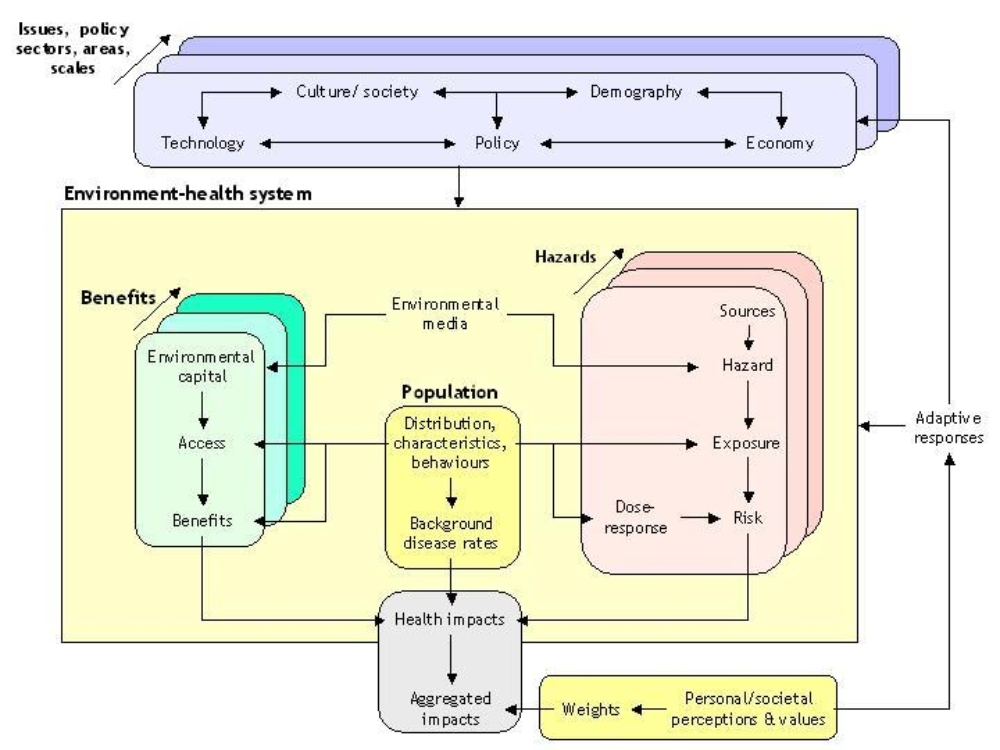
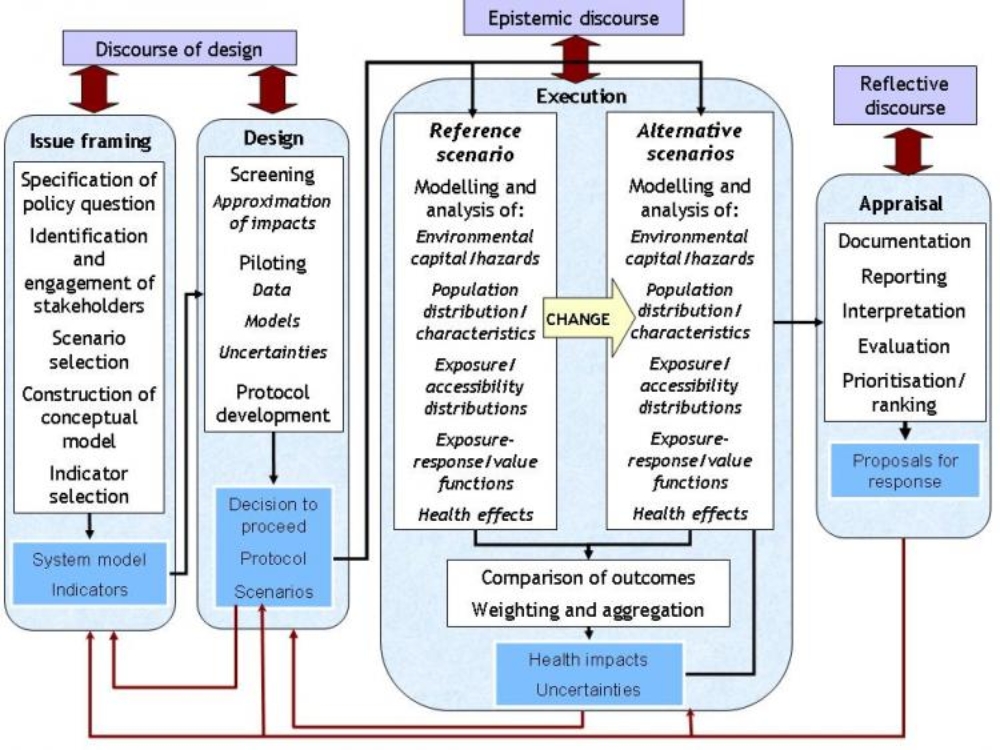
The detail information for this material is given in D51 – Revised review on integrated monitoring. It is available on http://www.intarese.org
There are a large number of existing and planned environment and health monitoring programs in Europe. Some major monitoring programs dealing with health risks of environmental stressors at national level are listed below and some of their features are summarized in Table 1. By concentrating on their use of integrated methodology, we want to focus on (i) the data information, (ii) integrated methodology and (iii) the potential that the integration of existing activity could have for supporting informed policy decision-making. Here, we create a ‘typology of programs’. Based upon this review we have identified three types of programs that followed the same main scheme.
• International, objectives of documenting trends and comparison across countries include a wide range of indicators, e.g. AMAP-Arctic Monitoring and Assessment Program, and ENHIS-European Environment and Health Information System.
• National, objectives of documenting general health trends focus on some health based indicators. e.g. GerES-German Environmental Survey, EHMS-the Environmental Health Monitoring System in the Czech Republic, PCBs-PCBs Monitoring and Assessment Projects in Slovakia, and KiGGS-The German Health Interview and Examination Survey for Children and Adolescents.
• National, objectives of following on a specific risk, including both observation and forecasting, e.g. HWWS-Heat Wave Warning System in France, and ONERC-National Observatory of Climate Change Impact in France.
A total of eight selected existing and planned integrated E & H monitoring network were reviewed in this report (see below). The reviewed information included:
• Project title
• Project location
• Team member name
• Review date
• Reviewer
• Project role
o Sponsor
o Project coordinator
o Project manager
o Team leader
o Team members
• Introduction
• Objectives
• Achievement of planned objectives
• Give details of activities in realization of objectives
• Time schedule of activities
• Data information
• Integrated methodology
• Budget (if available, per activity)
• Quality review
• Lessons learned as a result of the project
• Recommendations for action in relation to future projects
AMAP
The AMAP Trends and Effects Program, with a few exceptions, do not prescribe in detail the methods that should be applied in sample collection, pre-treatment or analysis. Rather it lists recommendations and references to internationally accepted methods and guidelines, including those developed under AMAP. It is regarded as convenient for participating laboratories and organizations to consider these recommendations and select methodologies appropriate to their circumstances; in some cases, methods may need to be adjusted to make them suitable for application under Arctic condition. In areas where no international guidelines or recommendations exist, the participants are suggested to try to agree on common and/or comparable methods based on existing experience.
» Read moreA section methodology of the AMAP Trends and Effects Program documentation includes the following parts:
• Part A. Methodological references: references to methods and guidelines that are appropriate as a basis for work to be carried out under the AMAP Trends and Effects Program, respectively:
o Atmospheric monitoring - Guidelines and methodological references
o Terrestrial monitoring - Guidelines and methodological references
o Freshwater monitoring - Guidelines and methodological references
o Marine monitoring - Guidelines and methodological references
o Biological effects monitoring - Guidelines and methodological references
o Guidelines and references on quality assurance
o Guidelines and references on tissue and specimen banking
o Guidelines and references on general monitoring issues (e.g. monitoring strategies, sample pooling, temporal trend analysis, normalization, etc.)
• Part B. References: A list of references cited in other sections of the AMAP Trends and Effects Program documentation.
• Part C. Annexes: Supplementary material, including:
o Annex 1. Overview of biological effects techniques applicable to the marine environment generally not including sea mammals and birds (ICES, 2000).
o Annex 2. Monitoring methods for biological effects of TBT in snails developed under the AMAP, including sampling locations, methods, temporal trend monitoring, field monitoring, storage of samplings, reporting information, quality assurance, data reporting and analytical procedures.
ENHIS
ENHIS methodological guidelines were developed for thirty indicators giving the rationale, definitions, required data elements, calculation methods, data sources, interpretations and policy-relevance. In order to ensure that the information collected on the indicators was consistent and user-friendly, a template for a methodology sheet was designed entailing the justification for the indicator, the definition of the indicator, underlying concepts and definitions, specification of the data needed, data sources, availability and quality, method of computing the indicator, scale of application, interpretation of the result, linkage with other indicators, details of any related data and websites, policy and regulatory context of the indicator and any relevant reporting obligations.
» Read moreA key starting point for ENHIS is the DPSEEA framework for environmental health indicators developed by the World Health Organization (WHO, 1999).
The cause to effect chain is described in the DPSEEA model by addressing Driving Forces, Pressures, State, Exposure, Effects and Actions, and provides a framework for analyzing interrelated factors that impact on human health.
The ENHIS indicators focus on the linkages between Exposure, Effects and Actions parts of the chain. In case of lack of information, proxies of exposures from upstream environmental determinants were used.
The DPSEEA main strengths are that it clearly shows the many different entry-points for interventions. However, despite its usefulness, the DPSEEA framework also has some drawbacks. In particular, it stresses the linear links between environment and health and thereby does not do complete justice to the actual complexity of the many non-linear associations between exposures and health outcomes.
EHMS
The Environmental Health Monitoring System in Czech Republic (EHMS) is an open system and has been developed continuously in terms of both the range of factors and pollutants monitored and methods of data processing and presentation.
• Health effects and risks related to air pollution (Subsystem I);
• Health effects and risks related to drinking water pollution (Subsystem II);
• Health effects of and annoyance from noise (Subsystem III);
• Health effects of and risks from dietary exposure to contaminants (Subsystem IV);
• Health effects of exposure to toxic environmental pollutants, human biomonitoring (Subsystem V);
• Health status and selected demographic and health statistics indicators (Subsystem VI);
• Health effects and risks related to the occupational environment (Subsystem VII);
• Health risks related to urban soil contamination (Subsystem VIII). » Read more Monitored factors and indicators and their limits
The indicators of the factors (pollutants, contaminants, analytes and indicators) related to air pollution, drinking water pollution, noise, dietary exposure, human biomonitoring and soil contamination, which have been monitored, is based on the respective regulations and analyses carried out both prior to the actual start and during the routine operation of the Monitoring System.
For evaluation of the results, several types of limits have been applied. On the one hand, these are limits given in Czech standards and regulations, and, on the other hand, these are values taken from documents of international or national institutions (e.g. the World Health Organization and US Environmental Protection Agency), which usually do not have the force of standards in the Czech Republic. Information system and data processing
The structure of the used databases and corresponding software enable the collection of results from the information system end users (measuring laboratories), their transport to the directors of the individual subsystems, and independent processing according to the requirements of the Monitoring System users. The directors archive all original data in databases for possible reprocessing according to other criteria, if needed. The databases are designed as standard products enabling data processing to the usual extent, are compatible with other database systems and allow additional data processing and evaluation, if required.
QA/QC system
Quality assurance (QA) and quality control (QC) in the participating laboratories in the Monitoring System have been included in their activities as well as in their home institutions. The participating laboratories serve as analytical units of the public health institutes, created after reorganization of the Public Health Service, private laboratories and laboratories of other institutions.
» Read moreThe QA system for analyses in the Monitoring System laboratories is based on the accreditation procedure steps focusing on:
• using standard operation procedures in all phases in the process of data collection and submission;
• using reference or certified reference materials as internal controls, keeping regulatory diagrams;
• participation in external control programs with inter-laboratory comparison of sample analyses at both national and international levels;
• meeting the requirements for keeping documentation records. Shortcomings
For economic and technical reasons not all subsystems of the Monitoring System have been in operation in all cities.
It should be noted that the calculation of individual statistical characteristics is limited by the number of values in the sample processed. For small numbers, only their mean value (arithmetic mean or median) is presented. Some data on a contaminant (analyte) concentration in an environmental medium or biological material may fall below the detection limit of the analytical methods used (so called “negative results” or “trace amounts”). If the concentration measured is below the detection limit, a value equaling one-half of the detection limits is used for the calculation of sample characteristics (based on the assumption of an even distribution of the values below the detection limit). This may lead to overestimated results; nevertheless, such an approach is safer than considering the values to be zero. Frequently, a greater number of the results can fall below the detection limit and their processing may be subject to error. If the number of the negative measurement results (i.e. falling below the detection limit) in the defined data set exceeds 50 %, the data on the given contaminant are usually described only verbally and their quantitative assessment is not routinely performed.
GerES
The German Environmental Surveys (GerES) conducted have provided representative data about the exposure of the adult population and are thus contributing to the environmental related health surveillance system envisaged by the German National Environment and Health Action Program (www.apug.de). For children aged 6 to 14 years such data have been collected in GerES II (1990/92). In GerES IV (2003/06), children aged 3 to 14 years were analyzed.
» Read moreOne method example from the GerES IV (Kolossa-Gehring and Becker, 2006): GerES IV is a module of KiGSS undertaken by the Federal Environment Agency. The target populations of the Health Survey are children and adolescents in Germany aged zero to 17 years registered in registration offices. Excluded are children living in institutions such as hospitals or children's homes. The GerES IV sample is drawn from this population in a multistage random sampling procedure (due to limited funding, it is not possible to study the entire sample of the Health Survey). The sub-sample comprises 1790 net cases aged 3 to 14 years. In each of 150 sampling locations, 12 children (one child of each one-year age group) are invited to take part. Due to limited funding, some parts of the survey program will be carried out on only 600 children. In these cases, one child from each of the four age groups 3 to 5 years, 6 to 8 years, 9 to 11 years, and 12 to 14 years will be randomly selected. Exposure to chemical pollutants, mould spores and noise was examined. This involved the analysis of blood, urine, house dust and drinking water samples, a screening audiometry and a questionnaire identifying factors relevant to exposure. Excluded are children living in institutions such as hospitals or children’s homes.
The fieldwork was conducted in cooperation with the Health Survey for Children and Adolescents, started in 2003 and finished in 2006. At each of the 150 sample points one of the three field teams operated for two weeks. A consultant was monitoring the quality of the fieldwork.
All chemical analyses were carried out by external laboratories. Contractors were required to meet high standards in terms of precision and accuracy. The laboratories of the Federal Environmental Agency, which did the analytical work in previous GerES, were part of the quality control system.
Primary steps before analyzing the data were checking and revising data, matching different data files, weighting (data have to be weighted according to the population characteristics like age, gender, community size and region).
The distributions of the substances in the different media were depicted for groups stratified by sampling characteristics (age, sex, size of town, former West-Germany/East-Germany) and important substance-specific variables. To describe the distribution the following statistical parameters were given: sample size, percentage of values below the limit of quantification, 10th, 50th, 90th, 95th, 98th percentile, maximum value, arithmetic mean, geometric mean and the 95 % confidence interval for the geometric or arithmetic mean. The 95% confidence intervals of the 95th percentiles were calculated for the different subgroups. These values were the basis to derive reference values for children from the age of 3 to 14 years in Germany.
Exposure routes, environmental conditions and individual patterns of behavior were evaluated by systematic hypothesis testing for selected relevant substances only. Results: Because the Federal Environment Agency had already included children in GerES II (1990–1992) subsequent trends in exposure levels can be identified. Exposure to lead, mercury, PAH and PCP has decreased markedly because of environmental and health policies. Exposure to second-hand smoke did not decrease, however. In both surveys, around 50 % of children were livings in households with at least one smoker. Urinary cotinine levels suggest exposure to second-hand smoke may even have increased. In almost half the households in which smoking occurred daily the future EU limit for benzene in outdoor air was exceeded in the indoor air. GerES IV will continue to examine links between environmental conditions and health. Around 10 % of children have been shown to be sensitive to at least one of the mould spores analyzed. Of the spores included in GerES, most are principally encountered in an indoor environment and are not covered by routine allergy screening tests. In the hearing test, around 13 % of children showed a loss of more than 20 dB, and 2.4 % more than 30 dB, in at least one of the frequencies measured. Noise from leisure activities is one potential cause of this hearing impairment.
KiGGS
This study was done using a nationwide representative investigation and survey to children and adolescents aged to 0 to 17 by the Robert Koch Institute (RKI). The data collected at an individual level include objective measures of physical and mental health as well as self-reported information regarding subjective health status, health behavior, health care services use, social and migrant status, living conditions and environmental determinants of health. The information was gained from interviews, physical examinations and blood and urine samples. Regional and seasonal factors were excluded by systematized route planning (Kurth, 2007).
» Read moreIn order to achieve a random sample, a total of 17,641 children and adolescents were surveyed, of whom 8,985 were boys and 8,656 were girls, and approx. 1,500 items were recorded. The survey was being undertaken in 167 randomly chosen locations of the Federal Republic of Germany from May 2003 to May 2006 by 4 teams, each consisting of a physician, interviewer, examiner, medical laboratory technician and an environmental interviewer. This number was found necessary in order to take in all the federal states and all community sizes, and to guarantee a representative picture of the target population (Kamtsiuris et al., 2007).
The sampling options were, on the one hand, a random sample from population registries and, on the other, a random sample of schools, and subsequently school classes for the 11 to 15 year age group and samples from population registries for the younger and the older age groups. After weighting up the advantages and disadvantages, a general random sample from population registries for all age groups was endorsed.
Invitation of the participants and appointments for examinations were handled by a survey office with subsidized service telephone. Data processing in the survey office was performed using an SQL (Structured Query Language) data base system programmed in the RKI (Robert Koch Institute), One central and several regional members of staff performing preparatory field visits were responsible for finding suitable examination rooms and for subject recruitment respectively. To further increase the response rate, continuous public relation actions were established. The survey involved questionnaires filled in by parents and parallel questionnaires for children from the age of 11 years onwards, physical examinations and tests and a computer assisted personal interview performed by the physician. The wide range of blood and urine testing carried out at central laboratories required standardized transport logistics. To achieve a high degree of standardization of the survey, the examination teams was initially trained and then underwent continuous further training. The concept of quality management covered action of internal and independent external quality control monitoring each data collecting and data processing step as well as the training courses (Holling et al., 2007). Conclusion: Dedicated public relations activities and the deployment of staff performing preparatory field visits increased the willingness of the subjects to participate. Intensive personnel care and continuous quality checks contribute to increased job satisfaction and data quality. By bindingly defining all laboratory diagnostic processes as well as transport logistics, high-quality laboratory test results were aimed. The conduct of the study from design via conduct to data processing and analysis by one institution would guarantee complete control of all steps of the survey (Holling et al., 2007). In addition, to some extent, KIGSS-specific components had already been used in other studies and only minor adaption were needed for the transfer (Kurth et al., 2008).
ONERC
The observatory was created in 2001 in France. The objectives were to collect and disseminate information, studies and researches on the risks linked to climate change, to formulate recommendations for action and prevention. » Read moreCollections of climate change indicators from different sources. These indicators are developed from several datasets, including:
• Chlorophyll concentration
• Tree-blossoms -date
• Grape gathering date St Emilion
• Grape gathering date ChâteauNeuf du Pape
• Grape gathering date Tavel
• Sea surface salinity
• Oversea department sea surface temperature
• Grape gathering date Champagne
• French mean temperature since 1901 World mean temperature since 1856
• Alpine ice mass
• Caterpillar territory between 1980 and 2005-2006
• Number of ice-days 1951-2000
• Number of summer-days 1951-2000
• Caterpillar territory 2005-2006
• Population data
• Identification of cities at risk
• Flower blossom
• Mean temperature, snow data - Isère
• Mean temperature in Guyana and Martinique
• Sea surface temperature
• Sea surface salinity in 13 Atlantic and Pacific points
• Sea surface temperature in 27 departments
• Ice mass Alps
• Ice mass St Sorlin
• Sea level in Noumea
• Sea level in Papete
Report on specific themes, e.g. Human health, relying on the indicators described above.
PCBs
Polychlorinated biphenyls were widely used in industrial and consumer products. Because these compounds are stable and highly lipophilic, their residues are ubiquitous and occur in increasing concentrations moving up through the food chain. In Slovakia, the Chemko – Strazske Chemical Company based in the Michalovce district, produced PCBs between 1959 and 1985. Improper disposal from the Chemko plant via release of effluent directly into the Laborec River resulted in long-term contamination of sediment; several studies in Slovakia between 1987 and 1990 found high levels of PCBs in food. Current data indicate that persons who eat locally raised food – pork, beef, poultry, and eggs – in this district have higher serum concentrations of PCBs.
» Read moreThere have been many projects under this program, at national level, including:
• Environmental exposure to PCBs and development of nervous system in
• Children
• Effects of PCB and dioxin exposure on mental and psychomotor development of infants
• Alteration of cognitive functions in children environmentally exposed to
• PCBs
• GIS analysis of PCB contamination in eastern Slovakia
• Alteration of hearing functions by PCBs
At international level, the projects are:
• Evaluating Human Health Risk from Low-Dose and Long-Term PCB Exposure (PCBRISK, QLK4-CT-2000-00488)
• Early Childhood Development and PCB Exposure in Slovakia (# R01-CA96525, NIH, USA)
• Ototoxicity of Early PCB Exposure (Fogarty International Research
• Collaboration Award, USA)
• Early Disease Biomarkers of PCB-exposed Human Population (National
• Institute of Environmental Health Sciences, US NIH)
The main objectives of all projects conducted in the eastern Slovakia are:
• to assess environmental PCB exposure of population, with the main focus on prenatal and early postnatal exposure of infants
• to evaluate effects of PCB exposure on health status of adult and children population, mainly disruption of endocrine and immune systems and neurobehavioral and developmental alterations.
Based on the results of the projects, no region in the eastern Slovakia can be thought of as being truly unexposed, as the background, concentrations are substantial. With the aim to get the complex picture of the size of the environmental and health problem, PCB monitoring and health effect assessment must be extended to other regions of eastern Slovakia, besides Michalovce and Svidnik/Stropkov.
HWWS
Following the 2003-heatwave, France developed a plan to prevent heat related health impacts during extreme heat waves. A complex set of intervention measures is activated in case of a alert. A heat warning system was designed to identify adverse weather situations and to trigger alerts. The indicators and thresholds were chosen based on the results of a retrospective analysis of the temperature-mortality relationship on fourteen cities.
The system relies on the monitoring of observed and forecasted meteorological indicators, air quality data and health data. Its objective is to identify heat waves that present a potential danger to public health and to orientate management measures.
» Read moreThe achievements of this project are:
• Develop a heat warning system based on meteorological forecasting (indicators and thresholds)
• Identify other environmental risk factors
• Identify relevant health outcome
• Organize this system at the local level
All data are provided daily at the sub-regional level:
• Temperature data are provided daily by the Meteorological Office with an indication of uncertainty:
o Minimal and Maximal temperatures for the day before and the 5 next days
o Minimal and Maxima temperatures averaged over 3 days for the day before and the 3 next days.
o Probability of the average of minimal temperature to be above a threshold
o Probability of the average of maximal temperature to be above a threshold
o Relative humidity for the day before and the 2 next days.
• Air quality data are provided by the Ineris, derived from the national model Prévair:
o -Mean of ozone in rural areas for the next two days
o -Mean of ozone in urban areas for the next two days
o -Mean of PM10 in rural areas for the next two days
o -Mean of PM10 in urban areas for the next two days
• Health data are provided by the hospitals (emergencies activities), and by the administration (mortality). Collection is automatized using web-based applications.
• Mortality data per causes are collected through notification of deaths. This can be either web-based (CepidDC portal for online notification of death) or paper-based (physicians filled an additional documents which is mailed to the Institute for Public Health).
The integration of the different data helps supporting the decision-making. The analysis is done using the following steps:
• Analysis of the temperature data, including the probability of being above threshold
• If the probability are medium to high, analysis of additional risk factors
• During a heat wave or immediately after, analysis of the health data to orientate the actions.
Table 1 Overview of eight integrated monitoring program in Europe. The abbreviation name is accordance with the name in the text above. The more detail information regarding the review of these eight programs is available in the D51 (http://www.intarese.org)
Project acronym
Location
Period
Data information
Integrated methodology
AMAP
The terrestrial and marine areas north of the Arctic Circle
1991-2012
Environment
Atmospheric contaminants
Marine contaminants
Radioactivity
Freshwater and terrestrial contaminants
Health
UV radiation and climate change
Guideline and methodology were developed for each monitoring system, quality control and general monitoring issues
EHIS
Europe
2008-
Environment
Air quality
Food safety
Chemical safety
Water and sanitation
Mobility and transport
Housing
UV and ionizing radiation
Occupational hazards
Health
Exposure of population to environmental stressors
Methodology was developed for thirty indicators giving the rationale, definitions, required data elements, calculation methods, data sources, interpretations and policy-relevance.
EHMS
Czech Republic
1994-2006
Environment (136 contaminant factors)
Air pollution
Drinking water pollution
Noise
Soil contamination
Health
Dietary exposure and human bio-monitoring
Methodology was developed for monitored factors and indicators and their limits, information system and data processing, and QA/QC system
GerES
East-, West-Germany
1985-2006
Environment
Domestic environment: tap water, dust deposit, content of vacuum cleaner bag and indoor air.
Community: water works sample and dust fall outdoors.
Health
Human bio-monitoring, diet and personal air
Methodology was developed for fieldwork, experimental chemical analysis, and data analysis (including checking and revising data, matching different data files, weighting etc.).
KiGSS
East-, West-Germany
1990-1992
2003-2006
Health (1990-1992, 4730 participants; 2003 -2006, 17,641 participants)
Measure: physical and mental health
Questionnaire: health status, health behavior, health care utilization, social and migrant status, living conditions
Environment
Environmental determinants of health.
Methodology was developed for the participants interviews, physical examinations, blood and urine samples, and data processing
ONERC
France
2001
Climate change (15 indicators)
Different sources
Several datasets
Population data
Exposure of population to climate risk
Report on specific themes, e.g. human health, relying on the indicators.
PCBs
Michalovce and Svidnik/Stropkov regions, Eastern Slovakia
2001-
Pollutants
PCBs and toxic metals.
Health (8 indicators)
Thyroid gland, glucose homeostasis and neurodevelopmental disorders
Report on specific themes, e.g. human health, relying on the indicators.
HWWS
France
2003-
Environmental variables
Temperature and air quality (O3, PM10)
Health
Mortality
I. Analysis of the temperature data, including the probability of being above threshold
II. If the probability are medium to high, analysis of additional risk factors
III. During a heat wave or immediately after, analysis of the health data to orientate the actions.